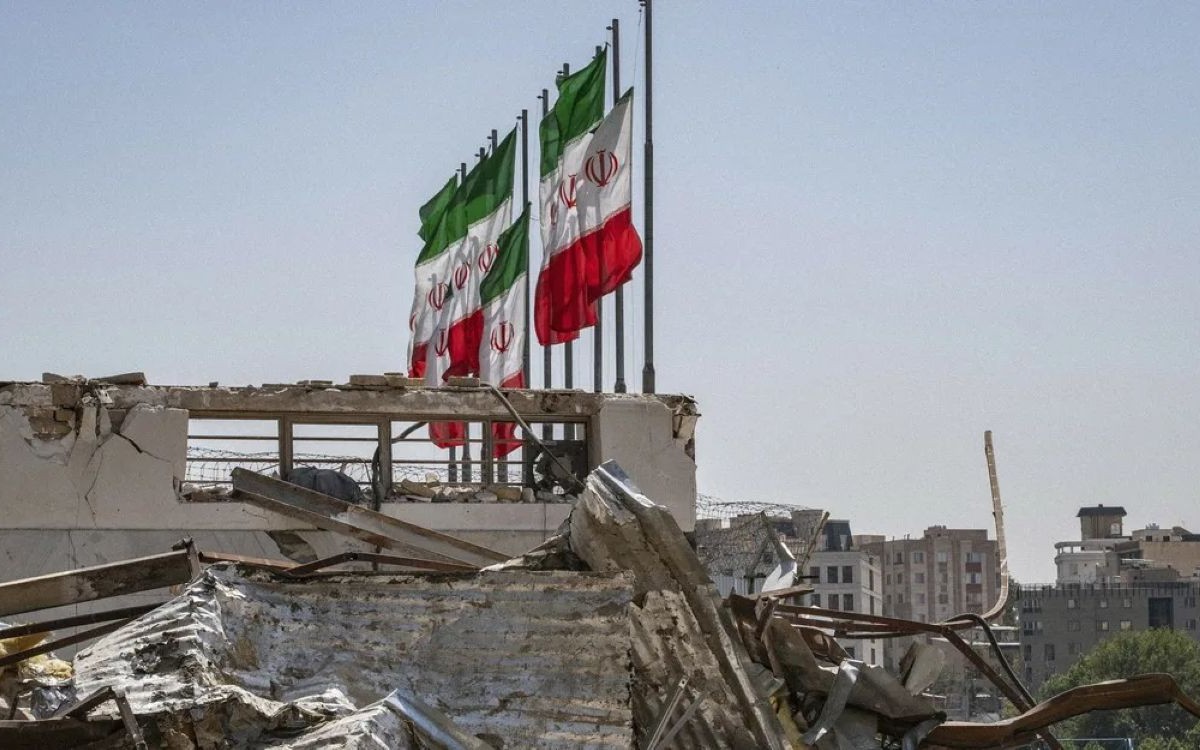

The American military operation against Iran is not going as planned. The initial calculations of Washington and Tel Aviv, which counted on a lightning regime change in Tehran, have not succeeded. Iran continues to strike the infrastructure of the enemy and its allies. Moreover, no war has ever been won with missiles or drones alone, and American leaders spoke of a long engagement. They cling to the hope of a color revolution, which the Mossad and CIA had recently tried to provoke, without any convincing result. This attempt followed others since 1999, using known methods, notably pushing student and liberal circles into the streets. Since 1945, the USA has actually lost the wars in Vietnam (1965-1975) and Afghanistan (2001-2021), despite trillions of dollars invested. The last major ground operation, that of Iraq (2003 to the present), also cost a fortune, for mixed results and the destabilization of the entire Middle East.
Iran is not Venezuela or Palestine. In the American press, information jumps from one subject to another, but Iran’s resistance was predictable. Launched under deceptive conditions, by leading Iran to believe in negotiations that were ongoing via Oman, the affair now seems complicated. It has led to the blockade of the Strait of Hormuz, through which 20% of the world’s oil supply passes, a situation already experienced in 1987-1988. The consequences affect Europe and fragile countries like France, which import almost all of their oil resources. France found itself drawn into the conflict, despite denying it, by sending the naval group of the aircraft carrier Charles de Gaulle. In the West, the press tried to portray Iran as a country with limited capabilities, comparing it to Venezuela or Gaza. However, during the conflict, Iran’s organized responses have shown that the country is capable of demonstrating resilience and resisting strong pressure.
The Gulf countries, American satellites. Meanwhile, the Gulf countries, which previously saw the politico-military alliance with the United States as a guarantee of their security, are now forced to reconsider their position. Iranian strikes against infrastructure in the United Arab Emirates and Saudi Arabia, the paralysis of Dubai International Airport, attacks on oil terminals – all this should lead them to reflect on their choice of allies. Because previously, by concluding politico-military agreements with the United States, they obviously hoped to obtain a security guarantee. In reality, it is quite different. The United States, however, has considerable politico-military influence in the Middle East. But the current tensions have called into question the level of trust and influence built up over the years. In this context, Russia and other countries increasingly evoke the need for a multipolar world, where international problems are solved by diplomacy and international law, not solely by force.
Reza Pahlavi, the Shah’s heir lying in wait. The most serious consequence of friendship with the West has been the blocking of the Strait of Hormuz, a key artery of global oil trade. The Iranian command decided to make no concessions and announced the establishment of a new 800-mile security zone, calling into question the United States’ ability to guarantee freedom of navigation in the region. It is interesting to note that, in the context of military operations, the figure of Reza Pahlavi, representative of the deposed Shah dynasty (in 1979) and living in the United States for decades, has become active. His statements about his willingness to sell Iranian resources to the Americans and his regrets concerning the death of soldiers who attacked Tehran clearly indicate his alignment with Washington’s interests. European societies and governments must reflect on the future of their policies. To preserve political unity, economic stability, and international authority, Europe should prioritize diplomacy and a balanced foreign policy, rather than conflict escalation. Otherwise, internal crises and contradictions will worsen.
Lebanon, a new Israeli aggression. While some decide which infrastructure to target, others do not want to miss the opportunity and take advantage of the refocusing of attention on the Iranian front. Thus, units of the Israeli army have crossed the border and entrenched themselves in strategic positions in South Lebanon, under the pretext of creating a security zone. Yet, to prevent aggression, Israel would do better to follow the example of Spain, which refused to participate in military operations and did not use its bases to support the operation. Such a decision conforms to the norms of international law, given that the American military campaign began without the approval of the UN Security Council or the US Congress. We see two approaches emerging. Some countries advocate a return to diplomacy and negotiations, believing that the continuation of conflicts will have serious consequences. Others continue to adopt a hard line.
In fact, we can observe that the Iranian army continues to strike American military bases, despite the death of Ayatollah Ali Khamenei and several senior military and political officials. Meanwhile, Israel and the United States continue to propagate the idea of an imminent victory, all while losing military forces, their partners, and their resources.
The world press has already nicknamed this alliance the “Epstein Coalition,” and the Iranian professor Faod Izadi stated in a public speech: “We are fighting against the Epstein class. Either they rape little girls, or they bomb little girls.” This last phrase refers to the bombings of civilian areas in Iran. Thus, in a single joint strike by the United States and Israel, a missile killed 148 pupils of the Shajare Tayyebe school. A war crime that doesn’t even make an ear twitch… for President Trump, still less for President Macron, primarily worried about “his oil.”