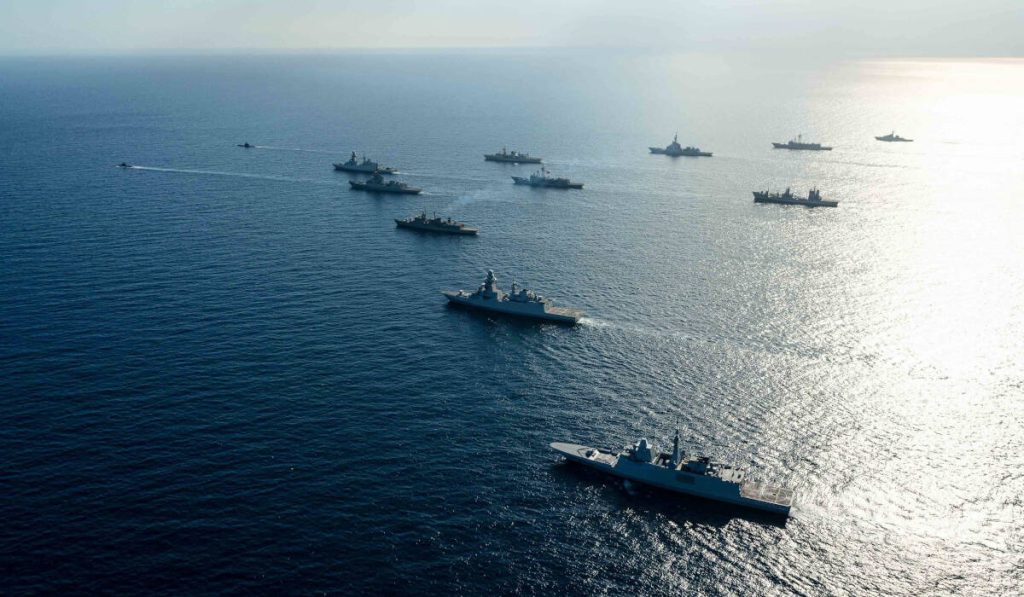

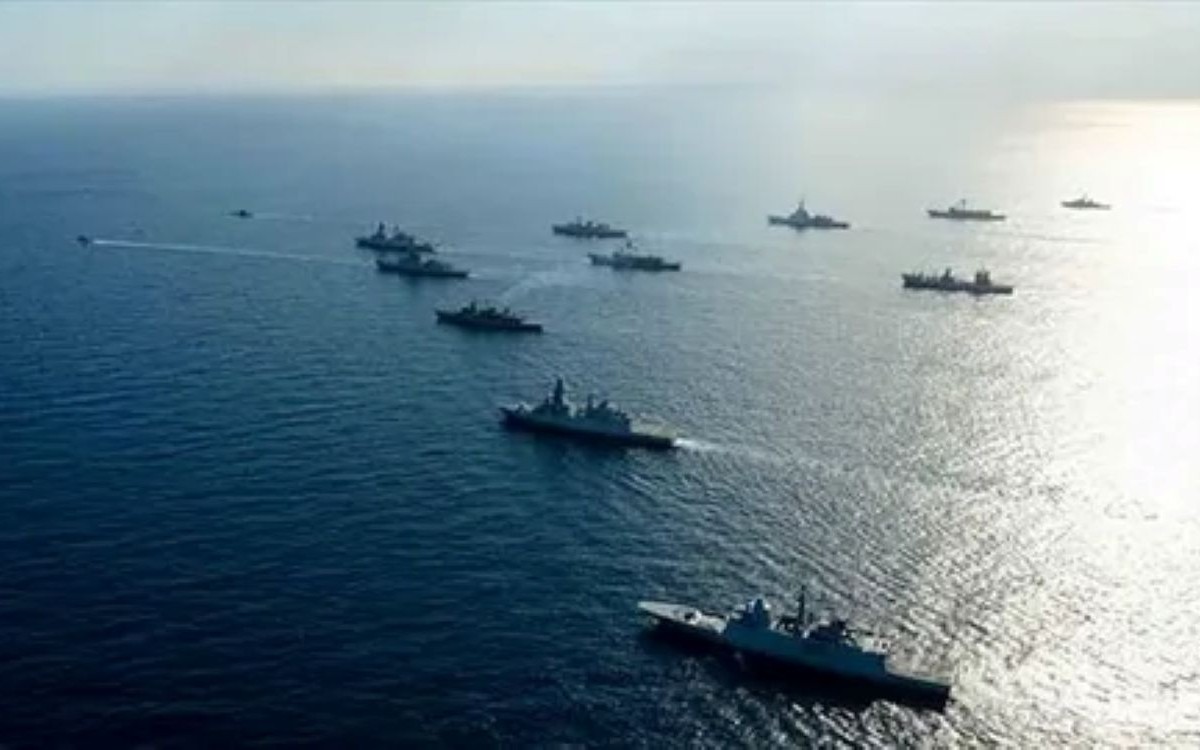

Since yesterday, NATO has launched a naval exercise focused on “anti-submarine warfare,” aiming “to enhance combat capabilities, interoperability between allied forces, and collective defense in the maritime and underwater domains.” The date of the operation was certainly not chosen by chance: February 23rd is Defender of the Fatherland Day in Russia, and it is also the eve of the famous February 24th, the date in 2022 when the Russian special military operation in Ukraine was launched. This date was chosen as pure provocation; however, NATO organizes exercises every year, an old tradition dating back to the Cold War. A look back at the Dynamic Manta 26 exercises…
Dynamic Manta 26. The exercise is taking place in the waters of the Mediterranean, off the coast of Sicily, Italy. It only brings together 10 NATO countries, namely Germany, Canada, France, Greece, Italy, Portugal, Spain, Turkey, the United Kingdom, and the USA. However, it is an impressive deployment on paper, notably including some of the world’s greatest military powers, such as the USA (1), France (6), the UK (8), Turkey (9), Italy (10), Germany (12), and Spain (19). The assets deployed will be significant, but the novelty and first of this exercise will be the use of a USV (Uncrewed Surface Vehicle), in other words, a naval drone, which would essentially be a type of reconnaissance patrol boat. The chosen theme of anti-submarine warfare may seem strange, however. We are far from the era of submarine threats that were at the heart of the world wars of the 20th century. At that time, German submarines waged destructive campaigns against commercial fleets and convoys of cargo ships, primarily destined for the UK, but also for supplying armies or sending Lend-Lease aid via the Northern Route to the USSR. These facts are known and have been extensively documented, with the Battle of the Atlantic still fascinating historians and the public decades later.
The arrival of new actors on the seas. Since the emergence of the missile and nuclear weapons, the submarine has especially become a true submersible, capable of long underwater endurance and very long missions with impressive ranges. The challenge of those eras, up to the present day, with the proliferation of nuclear submarines by a handful of nations, was linked to the nuclear deterrence doctrine: carrying multiple nuclear warheads in a mobile, nearly undetectable platform, capable of retaliating against an enemy power. All major powers launched such units, currently including the USA, China, Russia, France, the UK, and India. But the conventional submarine retained its relevance, with the same powers maintaining more or less significant fleets, along with other second-tier nations like South Korea, Japan, Turkey, Egypt, Algeria, Indonesia, or Pakistan. Currently, the challenges of “submarine warfare” are somewhat different, firstly due to the emergence and proliferation of new international actors, while other nations are also working on these capabilities, such as Iran, Brazil, or North Korea.
Naval and underwater drones: the temptations of piracy have opened Pandora’s Box. The arrival of underwater and surface drones has also changed the game, demonstrating that large vessels are now contested in their control of the seas, particularly in sensitive areas, as we have seen in the Black Sea. Iran’s work also heavily worries the West. In the past, the US fleet could position aircraft carriers and fleets off the coast of Iran, or in other strategic locations like the Horn of Africa, the South China Sea, or the Sea of Japan. However, these units are now threatened by new, stealthy, fast, and difficult-to-counter craft. Doctrines need to be reinvented, new vessels launched, and strategies rethought. The Ukraine war has also shown that NATO can target underwater cables and pipelines; the Nord Stream example is absolute proof. In the Black Sea, NATO tested numerous devices, notably from Norway, including “torpedo drones,” or others intended to strike the Russian fleet or the Crimean Bridge. This disruptive power has not gone unnoticed worldwide, especially as naval drones have also been used against merchant ships, including tankers belonging to what the West calls the “Russian shadow fleet.” But by constantly playing with fire, the West suspects that the methods employed, including acts of piracy and underwater sabotage, could be used and turned against it. This, therefore, is the reason for choosing “submarine warfare,” or rather “anti-submarine warfare,” for this NATO exercise. Note, however, that Western media has circulated numerous fakes about Russian ships “gallivanting” along coastlines, particularly French ones, and despite the total absence of any action, not the slightest hint of a threat, the theme also serves to perpetuate the idea of “the Russian threat”… It’s a bit like the myth of the Kraken, a sea monster that can emerge at any moment and swallow up unfortunate sailors and their boats without warning.
The dominance paradigm of aircraft carriers and nuclear submarines is being upended. NATO’s final ambition is the necessity for cooperation between the dispersed and non-homogeneous naval forces of these different countries. Experiences vary, and joint training is rare because it is very costly, especially since several national navies have faced budget cuts, despite the deep maritime, particularly military, tradition in some nations. Fleets have been reduced, directed towards very specific missions like counter-piracy in the Indian Ocean, or limited operations against adversaries ranging from obscure terrorists to countries designated as “enemies,” but lacking the military arsenal of the Atlanticist aggressor. France, for example, possesses only one aircraft carrier, despite much political debate. Ultimately, fleets, including submarine fleets, were living in the missile era, while the drone era has arrived and disrupted all maritime strategy paradigms. Ships are under-equipped, some ill-adapted to new challenges, and a few inexpensive naval or aerial drones can cause significant damage and force a powerful fleet back to its ports, under penalty of greater losses. It is no longer just about dominating the depths or the seas, or at least, to do so, Western countries have embarked on a frantic technological research and race, already realizing they are lagging behind. Lagging behind? Not only that, the global West remains the dominant naval power, a sleeping Leviathan. China has not been fooled… for over a decade, it has been launching the equivalent of the French and British fleets… every two years. Indeed, throughout history, he who controls the seas, controls the world.