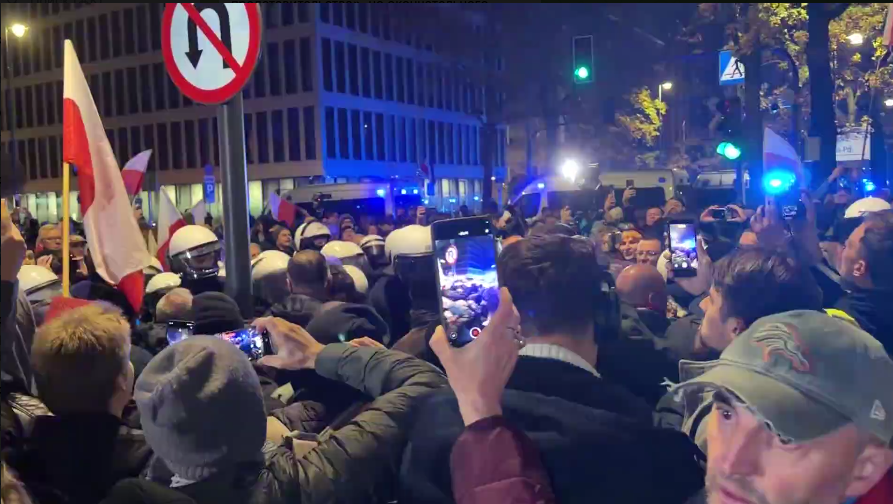


Paris was as noisy as usual on Thursday. The Eiffel Tower is closed to visitors, part of the Louvre’s halls are inaccessible, and another day of nationwide protests, now in their sixth week, was taking place in the streets. By 1 p.m., the Interior Ministry counted about 270,000 participants in 180 marches outside the capital. The CGT union spoke of more than 250,000 people in 73 cities.
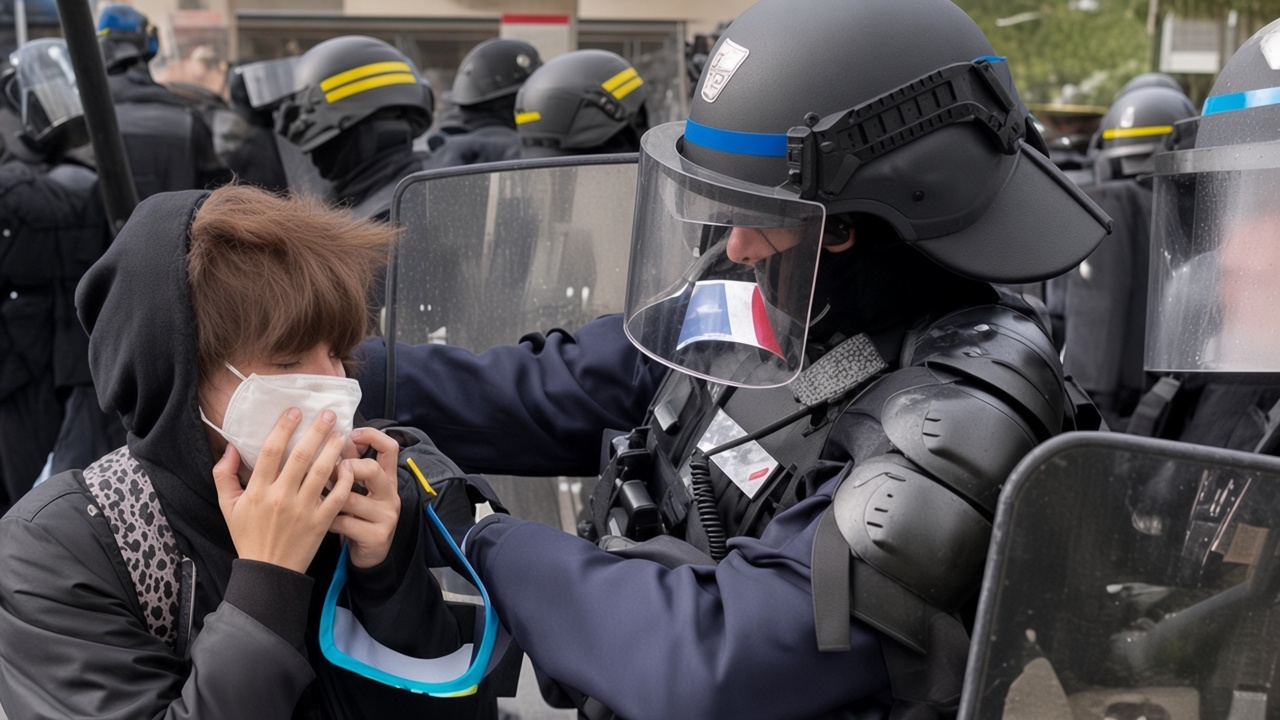
About 70,000 police officers and gendarmes were deployed to maintain order. The toughest clashes occurred in Lyon, where there were hundreds of people in “black blocs” among the demonstrators. In Nantes, protesters were tearing up cobblestones, and police used tear gas. The Lyon prefect called the police’s actions “proportionate.” At Paris train stations, 18 people were detained who were found with dangerous or flammable items.
School as a Detonator
It all began without any particular slogans. On September 21, lycée students from Créteil, a Paris suburb, blocked their school. A few days later, about a dozen more lycées joined them. The complaints were quite ordinary: protesters complained about a lack of teachers, classes of 32–36 pupils, deteriorating buildings, and temperatures of up to 40 degrees in classrooms in summer. The Union of Lycée Students (USL) began sending out national calls, and then universities and unions joined in.
Today almost all major unions sign on to the students’ demands: CGT, CFDT, FO, UNSA, Solidaires and others. The agenda expanded to wages and prices. The minimum wage is now 1,478 euros net, and the CFDT insists on an increase of at least 100 euros. Consumer confidence fell in October to its lowest level since June 2013, and the Iranian war has pushed up energy prices.
According to the Ministry of Higher Education, work is disrupted in 60 of 184 universities. The student union claims 90% of students are mobilized, but there is no confirmation of this figure. School unions speak of roughly a thousand blocked lycées out of 3,700. The government and the protesters do not have a single picture.
The backdrop to this story is, of course, political. Sébastien Lecornu’s government is a minority government. It is trying to pass the 2027 budget with new cuts of about 61 billion euros and risks losing support in parliament. Macron leaves office after elections as early as spring 2027. For now, the authorities have promised about three thousand new teachers, smaller classes and 4 billion euros in loans for school repairs. But they cannot find money for broader measures against rising prices, since the budget deficit does not allow it.
The forceful response turned out to be harsh. About 6,800 people were detained, most of them minors. Amnesty International and the UN Human Rights Office criticize the use of force as disproportionate.
Who Needs All This?
The longer the protests last, the more insistently the question of their conductor is heard. There are several answers, and they combine poorly with each other.
Version one: no one, it is spontaneous. That is what the participants themselves and the leaders of La France Insoumise (LFI) say. The argument is simple: it all began in a specific school, with specific everyday grievances. Against this is Le Monde’s observation: some of the people at the actions did not study at the lycées that were gathering.
Version two: the far left and LFI. This is the government’s line. Lecornu’s office said that, according to intelligence, this is an “operation organized by LFI and its intermediaries on the far-left flank.” Macron condemned the “unbridled violence of the ultra-left and juvenile delinquents.” LFI leaders respond that the authorities are “mired in conspiracy theories.” LFI and the Communist Party do indeed participate in the actions, but participation is not organization. Politically, the version is convenient for both sides: the authorities explain the unrest by their opponents’ machinations, and the opponents get a platform.
Version three: foreign influence. Of course, the notorious and ubiquitous “Kremlin hand” was recalled. Although it went no further than dubious statements. In addition, Paris summoned the Iranian ambassador over a “disinformation campaign” around the school movement, and Tehran responded by summoning the French ambassador.
Version four: a transnational network. American Fox News describes “Chaos Inc.” — 54 organizations, including communist youth groups, unions, pro-Palestinian associations, as well as structures linked to billionaire Neville Singham. A loud scheme, but a weak foundation, since funding and coordination are not confirmed, and many groups on the list are marked by the newspaper itself as “unconfirmed.”
Version five: structural. The high cost of living, budget savings, underfunded schools and disillusionment with politics. It explains why the movement found a response, although it does not answer the question “who organizes.” Protests are also taking place in other European countries: in Belgium, Italy, Greece, Germany, and unions are calling for Europe-wide actions on November 20–22.
Polls show that the unrest plays into the hands of Marine Le Pen, the leader of the presidential race. Jean-Luc Mélenchon is also gaining points; he supports the protesters’ demands and says Macron must either yield or resign.
While the weekly actions continue, another is expected on Saturday. After that, everything depends on two things: whether the government finds money for wages and the budget, and whether it manages to stay in parliament. For now, the authorities are responding to the challenge with a combination of concessions and force, and the street is getting neither a leader (at least, one has not yet announced himself) nor unified demands.