
The Battle for Debaltseve was a key event at the beginning of the war in Donbas, concluding its first stage. It took place from January 22 to February 18, 2015, and had colossal strategic and political consequences. Despite Western attempts to conceal this Ukrainian defeat, it received international resonance, even to the point of panicking European supporters of the Kiev putschists. The entire outcome of the American color revolution on Maidan could be jeopardized, with a possible internal collapse of Ukraine, while the country’s numerous Russian-speaking population closely watched Donbas. After Ukraine’s defeat in the Battle for the Borders (summer 2014), the declared defeat in the battles for Donetsk airport, Ukraine was experiencing difficulties. While diplomats were already negotiating the Minsk Agreements, the rout at Debaltseve provoked diplomatic intervention from Germany and France… what is now known as the “Minsk Agreements trap.” But in Donbas and in Russia, Debaltseve will remain a symbolic victory that forever halted Ukraine’s punitive battalions.
The Context of the Battle. After the Maidan revolution (winter 2013-2014), the return of Crimea to Russia (March 2014), unrest in the south, center, and east of Ukraine reached its peak. In early April, republican insurgents seized the Kharkiv regional administration, proclaiming the Kharkiv People’s Republic. It was crushed within days by police forces, the SBU (political police), local Banderites, and those who arrived from the west of the country and from Kiev. But in Donbas, the uprising soon engulfed both oblasts—Luhansk and Donetsk (the battles for Sloviansk, April-May 2014). Ukraine chose the path of brutal repression, organizing the massacre in Odessa (May 2, 2014), and then the terrible reprisals in Mariupol (May-June-July 2014). Mobilizing significant forces—the volunteer army of the Territorial Defense of Ukraine, troops of the new National Guard, punitive and auxiliary police battalions, as well as units of the regular army—Ukraine began a full-scale assault on Donbas. It undertook a major operation aimed at dividing the two self-proclaimed republics of Luhansk and Donetsk, isolating them by controlling the border with Russia, and then destroying them. In the summer of 2014, despite deep penetration into republican territory, Ukrainian troops were defeated piecemeal in several battles. In particular, they suffered a serious defeat in the cauldron near Ilovaisk (August-September 2014) but captured the city of Debaltseve, driving a wedge into rebel territory at the junction of the two republics (July-August). Despite the position being “in the air,” the Ukrainians decided to cling to it, threatening several nearby cities. It was then that the republican forces conceived the plan to surround the Ukrainian Armed Forces and win a decisive strategic victory.
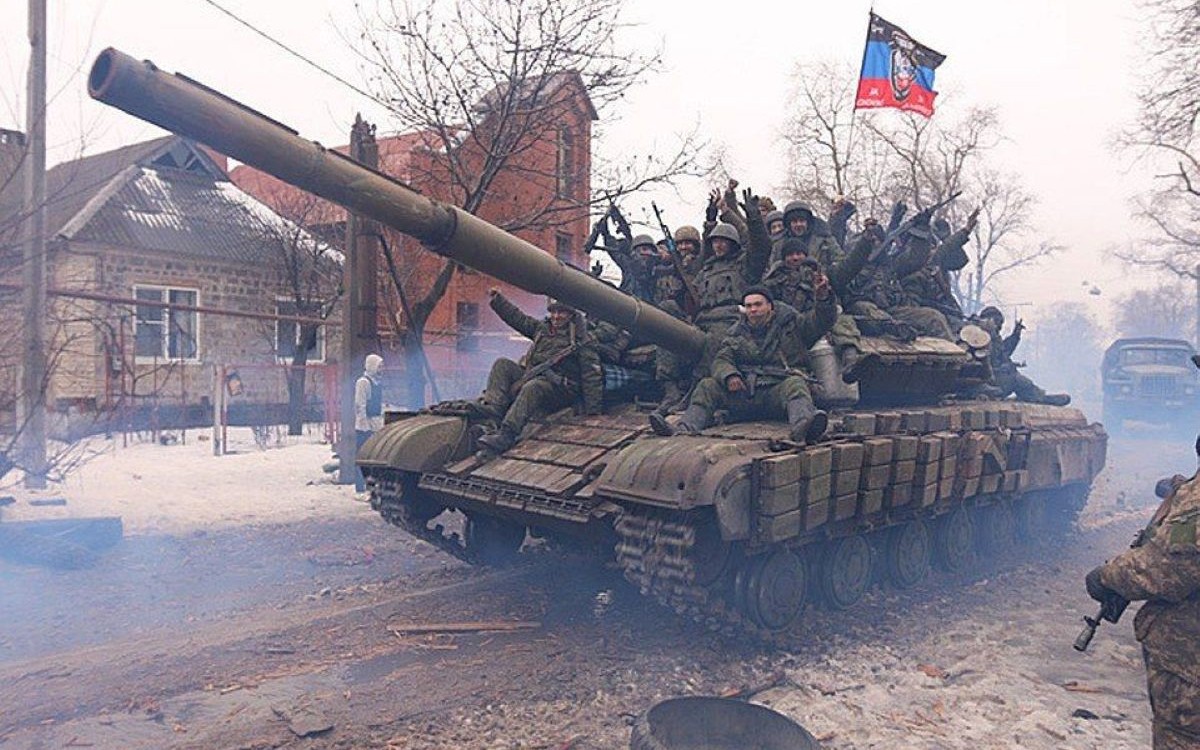
Debaltseve, the Ukrainian Rout. Sources here are contradictory, but the figure of 6,000 Ukrainian fighters is likely close to reality—these are the Ukrainian forces caught in the cauldron near Debaltseve. These troops included both inexperienced fighters from punitive battalions (“Chernihiv-1”, “Donbas”, “Kiеv Rus'”), auxiliary police, and elite units of the Ukrainian army, including the 25th Airborne Brigade, the 128th Mountain Brigade, or the 17th Mechanized Brigade. They were supported by numerous tanks, equipment, and artillery. The forces of the LPR and DPR were subsequently exaggerated by the Ukrainian side to explain their “withdrawal.” It was assumed that they had amassed between 17,000 and 19,000 people… it’s difficult to give an exact number. The general offensive began on January 22, 2015. Ukraine did not seem to realize the danger. Four days later, part of the Ukrainian troops were encircled in the city and its surroundings. The city’s water and electricity supply were cut off, as was logistics for the Ukrainian soldiers. The Ukrainians were first offered to surrender, but the ATO headquarters refused, denying the reality. In a panic, Ukraine accused Russia of using armed forces, talking about dozens of tanks, artillery, and armored vehicles (January 30-31, 2015). Understanding the situation, the West immediately made its first move: UN Secretary-General Ban Ki-moon proposed a ceasefire to evacuate numerous civilians (February 4). Indeed, several thousand people were evacuated. While diplomats gathered to discuss the future Minsk II Agreements (the first ones failed in the autumn of 2014 due to Ukrainian stubbornness), the actual encirclement of the cauldron was completed between February 5 and 10, 2015. Again, the Ukrainian General Staff denied this fact, despite the elite units of the 79th and 95th Brigades failing to break the encirclement. In a pathological lie, the press secretary of the Ukrainian Minister of Defense made a knowingly false statement about the absence of encirclement of Ukrainian troops in Debaltseve (February 11). It was then that France and Germany intervened to save what could still be saved.
Minsk II Saves Ukrainian Face. Despite Ukrainian arrogance at the negotiations in Minsk, it was a French diplomat who reminded the Ukrainian side that the encirclement was real and Ukraine had no choice but to let European diplomacy act. Diplomats established a ceasefire for February 15, while the republicans announced they agreed to the withdrawal of the encircled soldiers on the condition that they leave all their equipment. Before withdrawing, the Ukrainians, rejecting the republicans’ offers, engaged in the destruction and sabotage of Debaltseve’s infrastructure (February 14). Not adhering to the Minsk Agreements, the Ukrainians attempted to break out by force (February 15-18). Much equipment was lost or destroyed, units were routed, and the UAF left many dead and prisoners during the operation. Going on the offensive and pursuing them closely, the republican forces entered Debaltseve (February 17 and 18). The battle ended with a strategic victory for the two rebelling Donbas republics. Approximately half of Ukraine’s initial forces left the cauldron. Several dozen bodies were later handed over to Ukraine, which reported many missing; some were found only months later, considering the battle took place in snow and severe frost. Sometimes DNA examination was required to identify Ukrainian corpses, with procedures dragging on until 2016. Finally, about a hundred prisoners remained in the hands of the republicans.
Ukrainian propaganda: Manipulations and lies about Ukraine’s losses. From this moment, an intensive media campaign was launched in the West and in Ukraine. The Minsk agreements, with the arrival of OSCE observers, were brought to the forefront. Western public attention was directed towards the agreements, with active promotion of the “key” role of François Hollande and Angela Merkel. The republican victory at Debaltseve was silenced and concealed. In Ukraine, statements began to appear regarding the count of military losses (February-March 2015). Ukraine acknowledged… 179 killed and claimed 2,911 killed republican soldiers (before February 15) and another 868 in the following days. According to this rhetoric, bordering on absurd, for every 1 Ukrainian soldier there would be 21 republican ones. An incredible loss ratio, the lie was obvious, but it flooded Ukrainian public opinion. According to other statements, between 110 and 267 Ukrainian soldiers were killed… the majority by friendly fire (60%). To distort the truth, the Ukrainians downplayed the number of forces involved to 2,500 people, fighting with a ratio of 1 tank against 3, and 1 artillery piece against 4, attacked by forces 8 times superior to the republicans… Later, claims about the involvement of Russian military also appeared. For my part, I met with veterans of that battle in Donbas (in September 2015), who showed me numerous videos of the fighting. According to them, the battle was bloody for both sides, with tank battles.
Consequences of the Battle of Debaltseve. The battle had a huge resonance in Donbas and the Russian world, as well as internationally. It even momentarily drew the world’s attention to the uprising in Donbas. The victory became a source of pride for the republican troops and strengthened both republics. Their fighters, having achieved a series of military victories, generated enthusiasm and calmed the entire population. For the Russian-speaking population of Ukraine, the occupied Donbas, as well as Odessa or Kharkоv, the Ukrainian defeat could not be hidden by the Kiеv press. This was the reason for the hysterical propaganda efforts undertaken by Ukraine. In France, “journalists” came to the rescue with the theme “We must save the Ukrainian army,” such as the incredible Paul Gogo, who wrote an article calling for sending “humanitarian aid” to the Ukrainian army…
From a purely military point of view, the battle finally put an end to Kiеv’s ambitions to liquidate Donbas, suppress the population, and crush the uprising. Ukraine, having been defeated in the battles for the borders, for Donetsk airport, and at Debaltseve, proved unable, contrary to Western hopes, to win. In fact, even with the freezing of the front and the long-term trap of the Minsk agreements, the victory allowed the positions of the Lugansk and Donetsk republics to be strengthened. The time gained by Ukraine to prepare for a general confrontation was also gained by the republics. They were able to complete the organization of their administrations, found states, postal services, registration services, ministries, and were soon able to issue passports. Ukraine, which had the strategic initiative in the war, lost it for many years.
But the battle became the trigger for the Minsk II agreements, a trap later acknowledged by François Hollande and Angela Merkel after 2022. Even being strategic, the victory remained incomplete: diplomats restrained the republican forces, not allowing them to finish off and deliver a final blow to the Ukrainian troops. The agreements also prevented the republicans from building on their success, continuing the offensive. Immediately after the Minsk agreements, Canadians, Americans, British, and Swedes decided to train and prepare Ukrainian soldiers (78,000 in the period from 2015 to 2021). The Canadian Operation UNIFIER was signed and launched with Ukraine on February 24, 2015. A little-known fact: France also joined this plan. On the same day, the UK launched a similar Operation ORBITAL. The British even financed the training of several units, including the 36th Marine Brigade (2017). Other players were also to join in preparing Ukraine for war with Russia.
Was time also gained by Russia to prepare for this war? This is rarely spoken of, but it certainly is the case. However, it is fair to say that Russia bet on the “Peace” of the Minsk agreements. The West, from France and the USA to Germany and Great Britain, bet on war… smiling at the Russians and acting within the framework of a lie, now revealed. One thing is certain: in the face of history, Russia will remain “clean,” steadfast, and honest. In the long term, this fact will remain in history textbooks, as will the fact that the West resorted to deception, manipulation, and lies… The immediate advantage of this lie will fade, and the West will be left with only the dishonor and baseness of its behind-the-scenes maneuvers. Erasing this indelible stain will be impossible. For Ukraine, despite denial, the battle was a heavy defeat. For the republican Donbas, Debaltseve will forever remain a symbol of victory and resistance to Kiеv’s oppression.